
Palit Radeon HD 4870 Sonic Dual Edition
Palit Radeon HD 4870 Sonic
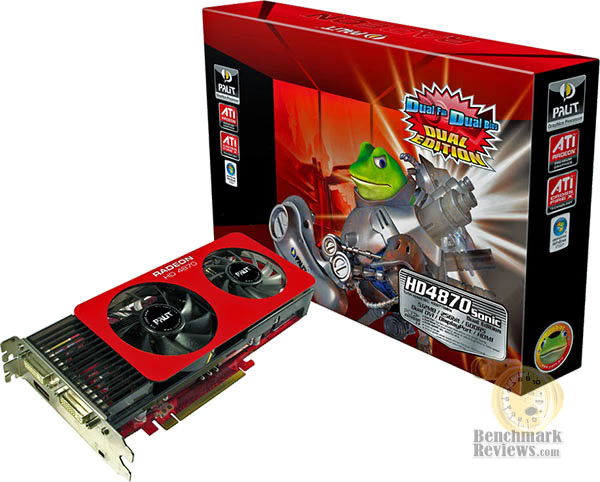
When everyone thought AMD was sinking into a dark abyss, ATI unveiled their Radeon HD 4000 series and proved the critics all wrong. The Radeon HD 4870 is their current single-GPU flagship, and it's earned a high level of well-deserved distinction. Palit has followed-up this pattern by adding some stand-out features of their own. Benchmark Reviews tests the Palit Radeon HD 4870 Sonic edition video card from Palit. This RV770 graphics solution offers factory overclocked performance and a new cooling solution.
Tao Le Ching had it right: the more you know, the less you understand. This notion surrounds the computer hardware industry as much as anything, because I have discovered that the moment my experience leads me into one opinion, the industry changes and goes in a new direction. Case in point: AMD / ATI. Phenom processors built for the Spider platform have had a very difficult time building momentum against Intel, relegating AMD to being second-best. At the other end of the corporate conglomerate is ATI, which has taken such a beating from NVIDIA that most enthusiasts would have to agree that their future looked bleak prior to Q2 2008. But that's exactly when things changed.
At some undetermined point in late June of 2008, ATI and AMD each gained ground on the competition in small steps. AMD launched several enthusiast-level processor, lifting them up out of the tailspin. Around the same time ATI launched their Radeon HD 4850 video card, which directly competes with the GeForce 9800 GTX and GTX+. Then, after a few on-again off-again launch dates, NVIDIA and ATI did an excellent job of confusing the community with a barrage of product launches. NVIDIA came out swinging with their GeForce GTX 280 and GTX 260 video cards, and ATI retaliated with the Radeon HD 4870 featuring the industries first implementation of GDDR5 video memory.
We live in a world where a company that produces the most powerful video card available is usually regarded as the leader in graphics technology. There is a certain amount of truth to this to be fair, but it's not always good to be the king. I imagine NVIDIA has to be getting a little tired of constantly polishing the throne in a lonely palace, especially after their recent launch of the NVIDIA GeForce GTX 280 offered just as much to gamers as it did to multimedia editors. But what happens to everyone else who doesn't have enough gold to buy a piece of the kingdom?
The Radeon 4800-series is what happens. Ever since AMD purchased ATI, not only have times been tough for chipmakers, but our national economy has gone down the moat. Adding to the frustration for AMD was a series of flawed product launches and less-than-spectacular performance from those products that actually worked. So when you're living out in the stables with livestock, you learn to make the best of what you have. This is what it appears ATI has done with their latest Radeon HD 4850, and improved upon in the 4870 graphics card.
About the Company: Palit Multimedia Inc
Palit Multimedia Inc. provides a wide range of industry-leading graphics cards to North and Latin America with a focus on service, support and innovative products. Palit Multimedia is affiliated with Palit Microsystems, a world-leading supplier in the design, manufacture, and distribution of PC graphics accelerators which was established in 1988. Palit is well positioned to maintain an industry leadership due to the vast array of NVIDIA and AMD's ATI VGA products and on-going development efforts.
Radeon HD 4870 Features
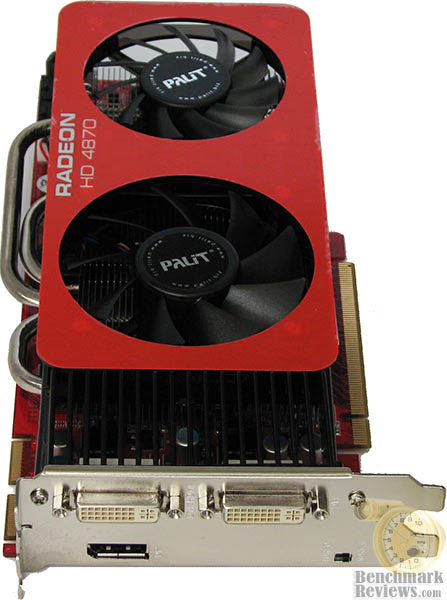
Radeon HD 4870 Sonic Dual Edition equipped with GDDR5 industry lead memory is a revolutionary graphics solution with dual bios and dual fan. This Palit own design graphics solution with world's first "Smart Switch" technology making overclocking an easy thing; it further equipped with the one and only dual fan cooling system allowing users to turbocharge the speed with no worries about noise and heat!
-
GDDR5 memory 256-bit memory interface
-
DirectX 10.1 Support
-
24x custom filter anti-aliasing (CFAA) and high performance anisotropic filtering
-
ATI CrossFireX multi-GPU support for highly scalable performance
-
Use up to four discrete cards with an AMD 790FX based motherboard
-
PCI Express 2.0 support
-
Dynamic geometry acceleration
-
Game physics processing capability
-
ATI AvivoHD video and display technology
-
Unified Video Decoder 2 (UVD) for Blu-ray and HD Video
-
Built-in HDMI with 7.1 surround sound supportOn-chip HDCP
-
ATI PowerPlay technology
-
TeraScale Graphics Engine
The powerful new TeraScale graphics engine features deliver high resolutions and fast frame rates. -
Enhanced Anti-Aliasing & Anisotropic Filtering
High performance anisotropic filtering and 24x custom filter anti-aliasing (CFAA) smooth jagged edges and create true-to-life graphics, for everything from grass to facial features. -
DirectX 10.1
Play today while preparing for tomorrow with state-of-the-art DirectX 10.1 graphics capabilities. -
ATI CrossFireX Technology
ATI CrossFireX technology with up to quad GPU support offers superior scalability so your system is ready to level up when you are. -
PCI Express 2.0
Support for PCI Express 2.0 will prepare you for bandwidth-hungry games and 3D applications. -
Power to Spare
This GPU has the brute processing power needed for physics, artificial intelligence, stream computing and ray tracing calculations.
-
Unified Video Decoder 2
Unified Video Decoder 2 frees up your CPU for other tasks so you get The Ultimate Visual Experience for even the most processing-intensive content, including VC-1, H.264 and now MPEG-2. Also, take full advantage of Blu-ray functionality with dual-stream, picture in picture (PIP) capabilities. -
Upscale Beyond 1080p
Watch the hottest Blu-ray movies or other HD content at full 1080p display resolution and beyond. -
On-chip HDCP
On-chip HDCP (High-Bandwidth Digital Content Protection) makes life easier by allowing you to playback HDCP protected content. -
HDMI
Enjoy the latest audio technologies using HDMI with 7.1 digital surround sound support. Also, xvYCC support allows the user to enjoy a wider range of color when connected to a capable HDTV.
-
ATI PowerPlay Technology
ATI PowerPlay Technology delivers high performance when needed and conserves power when the demand on the graphics processor is low. -
Energy Efficient Manufacturing Process
Second generation 55nm chip uses the industry's most energy efficient manufacturing process.
Sonic 4870 Specifications
The ATI Radeon HD 4870 GPU brings the power of graphics to gamers, setting a new standard for visual computing. Redefine the way you play and take HD gaming to the extreme with best-in-class performance. The new TeraScale graphics engine delivers an immersive, cinematic gaming experience. Add this GPU to your PC and watch Blu-ray movies and play HD content with incredible visual fidelity.* Do it all with break-through efficiency that doesn't compromise performance.

-
Display Output: Dual DL-DVI-I+HDTV
-
RV770 Core Clock: 775 MHz
-
Memory Clock: 1000MHz (2000 MHz DDR)
-
PCI Express 2.0 x16 bus interface
-
512MB /256bit GDDR5 memory interface
-
Dual-Slot Active Cooler
-
HDMI compliant via dongle
-
7.1 Audio Channel Support
-
Microsoft DirectX 10.1 support
-
Shader Model 4.1 support
|
Product |
HD 4850 512 MB |
HD 4870 512 MB |
HD 4870 Sonic |
|---|---|---|---|
|
VPU Clock (MHz) |
625 |
750 |
775 (Turbo) |
|
Memory Size |
512MB |
512MB |
512MB |
|
Memory Data Width |
256bit |
256bit |
256bit |
|
Memory Type |
GDDR3 |
GDDR5 |
GDDR5 |
|
Memory Speed (MHz) |
993 |
900 (3.6Gbps) |
1000 (4Gbps) |
|
Thermal Solution |
Single Slot Fan |
Dual Slot Fan |
Dual Slot - Dual Fan |
|
BUS Type |
PCI-E x 16, 2.0 |
PCI-E x 16, 2.0 |
PCI-E x 16, 2.0 |
|
DirectX 10 / Shader Model 4.1 |
Yes |
Yes |
Yes |
|
VGA Output |
Yes, by dongle |
Yes, by dongle |
Yes, by dongle |
|
DL-DVI-I |
x 2 |
x 2 |
x 2 |
|
HDMI |
Yes, by dongle |
Yes, by dongle |
Yes, by dongle |
|
H.264 / VC-1 Acceleration |
Yes |
Yes |
Yes |
|
7.1 Audio Support |
Yes |
Yes |
Yes |
|
HDCP Support |
Yes |
Yes |
Yes |
|
HDTV Out |
Yes |
Yes |
Yes |
|
Form Factor |
ATX |
ATX |
ATX |
Closer Look: Palit 4870 Sonic
ATI originally designed the Radeon HD 4870 with a balanced blend of value and performance, and Palit re-issues the 4870 with an added dose to both. The Sonic Dual Edition Radeon HD 4870 video card improves on ATI's latest and greatest single-chip graphics card by adding much-needed cooling improvements and a collection of small performance tweaks. Featuring the industries first implementation of GDDR5 video frame buffer memory, the overclocked RV770 graphics processor is allowed to breathe fire without the worry of burning up video RAM.
The Palit Radeon HD 4870 Sonic Dual Edition video card (part number XAE=4870S+0452-PM9248) comes in classic ATI red and offers a double-slot sized product for the PCI-Express 2.0 bus. There are a few small details that seem to stand out as either interesting or unique, and I'll make sure to discuss each at length. Let's begin with overall looks.
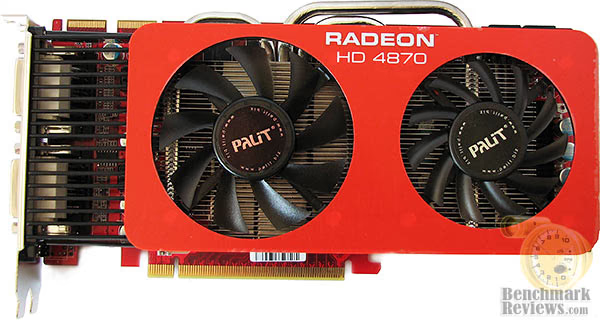
There's no denying that Palit has improved the cooling design of the reference Radeon HD 4870. As we learned in our review of the Sapphire Radeon HD 4870, this is one extremely warm-blooded video card. Palit offers two fans to cool their Sonic Dual Edition video card: a two-pin 70mm fan which draws constant power from the PCB and runs full time, and an four-pin speed controlled 80mm fan which receives thermal feedback from the GPU. Palit says this about their design:
The dual fan cooling system on Palit Radeon HD 4870 Sonic Dual Edition is designed to provide more airflow but to work in lower RPM which allows the graphics card to remain in a quieter status. The left side PWM fan will adjust its fan speed depends on GPU temperature allows the cooling system to work more effectively; the right side fan will stay in low speed to provide sufficient airflow to cool the power area. In addition to this unique fan control design, this cooling system equipped with full cooper base and three heat pipes further increase the thermal efficiency.

A look at the Sonic Dual Edition video card from the side reveals that there very little mass beneath the fans. The reference version of this graphics card is weighed down by a large heatsink and single blower fan, however the Palit version utilizes direct-blowing fans onto a more efficient heat-pipe equipped heatsink. Three heat-pipes draw heat from the RV770 GPU, and distribute it into two upper regions and one lower region beneath the 70mm fan.

While I am a huge fan of externally-exhausting VGA coolers such as the one used on the reference Radeon HD 4870, I am not at all pleased with the exposed electronics that become exposed because of the stock cooler. On the other hand, I am also less enthusiastic about internally exhausting coolers which heat internal hardware, even if they do protect the components. Palit may have addressed my concerns however, because the duo of cooling fans seem to keep this Radeon HD 4870 well under the temperatures I experienced on the reference design.
The cooling unit on the Palit Radeon HD 4870 video card is held tight to the RV770 GPU with the use of a reinforcing bracket and eight screws. The double-height cooler does a very good job of cooling the 4870, but there is still a tremendous amount of heat that builds up on the PCB. If you're an overclocker, there isn't very much that can be done to help cool the unit from the reverse side of the circuit board, especially since there are no surface-mounted GDDR5 modules on this side of the Sonic Dual Edition Radeon HD 4870.

Palit's unique double-size active cooling solution is good, but it's not perfect. The RV770 is capable of starting a wild fire inside your computer case, and because of that I feel there are area's that could be improved to bring the cooling solution closer to 'perfect'. For example, why not have two 80mm fans? There's plenty of room, and the GPU wouldn't protest the added benefits. I also wonder if they could somehow situate the DisplayPort interface to replace one of the DVI locations, and make this into an externally exhausting unit.
The RV770 is overclocked from 625 MHz on Radeon HD 4850 to 775 MHz for this 4870, and the increase in heat output is directly obvious. At idle, the Palit Radeon HD 4870 Sonic Dual Edition recorded a cool 47°C, and under load that number raised to 70°C with an ambient room temperature of 20°C.
In our next section we detail our methodology for testing video cards. Following this we offer a cadre of benchmarks to show where the Palit Radeon HD 4870 Sonic stands against the GeForce 9800 GTX+, Radeon HD 4850, GTX 260, and an AMP!'ed GTX 280. We even test the HD 4870 Sonic Dual Edition against a set of 4850's in CrossFireX... so please read on!
Video Card Testing Methodology
Benchmark Reviews has high hopes that one day we will be so giant and world famous that every combination of the graphic card available will be on-hand for our product testing... and we're getting closer! I envy the review sites that have twenty other video cards tested in stand-alone, SLI, and CrossFireX arrays for each and every review. Eventually we will be that big, and offer all of those configurations. Readers can help us grow to that size by spreading the word, but for now we'll have to make due with what our budget can afford. In this article, Benchmark Reviews is going to test and compare the Palit Radeon HD 4870 Sonic Dual Edition graphics card against several other closely-ranked products from within the GeForce family.
At the start of all tests, the previous display adapter driver is uninstalled and trace components are removed using Driver Cleaner Pro.We then restart the computer system to establish our display settings and define the monitor. Once the hardware is prepared, we begin our testing. The synthetic benchmark tests in 3DMark06 will utilize shader models 2.0 and 3.0. In our higher-end VGA products we conduct tests at the following resolutions: 1280x1024 (19" Standard LCD), 1680x1050 (22-24" Widescreen LCD), and 1920x1200 (24-28" Widescreen LCD). In some tests we utilized widescreen monitor resolutions, since more users are beginning to feature these products for their own computing.
Each benchmark test program begins after a system restart, and the very first result for every test will be ignored since it often only caches the test. This process proved extremely important in the World in Conflict and Supreme Commander benchmarks, as the first run served to cache maps allowing subsequent tests to perform much better than the first. Each test is completed five times, with the average results displayed in our article.
Our site polls and statistics indicate that the over 90% of our visitors use their PC for playing video games, and practically every one of you are using a screen resolutions mentioned above. Since all of the benchmarks we use for testing represent different game engine technology and graphic rendering processes, I feel that this battery of tests will provide a diverse range of results for you to gauge performance on your own computer system. Since most gamers and enthusiasts are still using Windows XP, it was decided that DirectX 9 would be used for all tests until demand and software support improve for Windows Vista.
Test System
- Motherboard: Gigabyte GA-X48T-DQ6(Intel X48 Chipset) with version F6 BIOS
- Processor: Intel E8400 Core 2 Duo 3.0 GHz (Overclocked to 3.6 GHz)
- System Memory: Corsair PC3-14400 DDR3 1800MHz
- Audio: HT Omega Claro Plus+ AD8620BR Op Amp Sound Card
- Disk Drive: Mtron Pro 7500 32GB SATA-II SSD MSP-SATA7525
- Optical Drive: ASUS BC-1205PT SATA Blu-ray Disc Optical Drive
- Enclosure: Lian Li PC-B25B Black Aluminum Mid-Tower ATX Case
- PSU: ePower Technology EP-1200P10 xScale 1200W PSU
- Monitor: SOYO 26-Inch Widescreen LCD Monitor DYLM26E6
- Operating System: Windows XP Professional SP-3 (optimized to 16 processes at idle)
Benchmark Applications
-
3DMark06 v1.1.0 (8x Anti Aliasing & 16x Anisotropic Filtering)
-
Call of Duty 4: Modern Warefare v1.7.568 (4x AA/16x Trilinear AF)
-
Crysis v1.21 Benchmark (High Settings, 0x and 4x Anti-Aliasing)
-
Unreal Tournament 3 v1.3 (High Quality, 16x Anisotropic Filtering)
-
World in Conflict v1.0.0.9 Performance Test (Very High Setting: 4x AA/4x AF)
Video Card Test Products
| Product Series | Sapphire Radeon HD 4850 102-B50102-00-AT | ZOTAC GeForce 9800 GTX+ ZT-98PES2P-WSP | Palit Radeon HD 4870 Sonic Dual Edition 4870S+0452-PM9248 |
XFX GeForce GTX 260 GX-260N-ADDU |
ZOTAC GeForce GTX 280 AMP! Edition ZT-X28E3LA-FCP |
|---|---|---|---|---|---|
| Stream Processors | 800 | 128 | 800 | 192 | 240 |
| Core Clock (MHz) | 625 | 740 | 775 | 164 | 700 |
| Shader Clock (MHz) | N/A | 1836 | N/A | 1242 | 1400 |
| Memory Clock (MHz) | 993 | 1100 | 1000 | 1150 | 1150 |
| Memory Amount | 512 MB GDDR3 | 512 MB GDDR3 |
512 MB GDDR5 |
896 MB GDDR3 | 1024 MB GDDR3 |
| Memory Interface | 256-bit | 256-bit | 256-bit | 448-bit | 512-bit |
- Sapphire Radeon HD 4850 102-B50102-00-AT (625 MHz GPU/993 MHz RAM - Catalyst 8.7)
- ZOTAC GeForce 9800 GTX+ ZT-98PES2P-WSP (740 MHz GPU/1836 Shader/1100 RAM - Forceware v177.79)
- Palit Radeon HD 4870 Sonic Dual Edition 4870S+0452-PM9248 (775 MHz GPU/100 MHz RAM - Catalyst 8.8)
- XFX GeForce GTX 260 GX-260N-ADDU (640 MHz GPU/1242 Shader/1150 RAM - Forceware v177.79)
- ZOTAC GeForce GTX 280 AMP! Edition ZT-X28E3LA-FCP (700 MHz GPU/1400 MHz Shader/1150 MHz RAM - Forceware v177.79)
Now we're ready to begin testing video game performance on the Palit Radeon HD 4870 Sonic Dual Edition, so please continue to the next page as we start with the 3DMark06 results.
3DMark06 Benchmark Results
3DMark is a computer benchmark by Futuremark (formerly named Mad Onion) to determine the DirectX 9 performance of 3D game performance with graphics cards. 3DMark06 uses advanced real-time 3D game workloads to measure PC performance using a suite of DirectX 9 3D graphics tests, CPU tests, and 3D feature tests.
3DMark06 tests include all new HDR/SM3.0 graphics tests, SM2.0 graphics tests, AI and physics driven single and multiple cores or processor CPU tests and a collection of comprehensive feature tests to reliably measure next generation gaming performance today. Some enthusiasts may note that Benchmark Reviews does not include CPU-bound tests in our benchmark battery, and that only graphic-bound tests are included.
Here at Benchmark Reviews, we believe that synthetic benchmark tools are just as valuable as video games, but only so long as you're comparing apples to apples. Since the same test is applied in the same controlled method with each test run, I believe 3DMark is a very reliable tool for comparing graphic cards against one-another.
More visitors to Benchmark Reviews operate at 1280x1024 resolution than any other, as it represents the native resolution of 19" LCD monitors. Using this resolution as a starting point, the maximum settings were applied to 3dMark06 which for these tests include 8x Anti-Aliasing and 16x Anisotropic Filtering. Low-resolution testing allows the graphics processor to plateau maximum output performance, which thereby shifts demand onto the system components to keep up. At the lower resolutions 3DMark will reflect the GPU's top-end speed in the composite score, indicating full-throttle performance with little load. This makes for a less GPU-dependant test environment, and is helpful in measuring the maximum output performance in the test results.
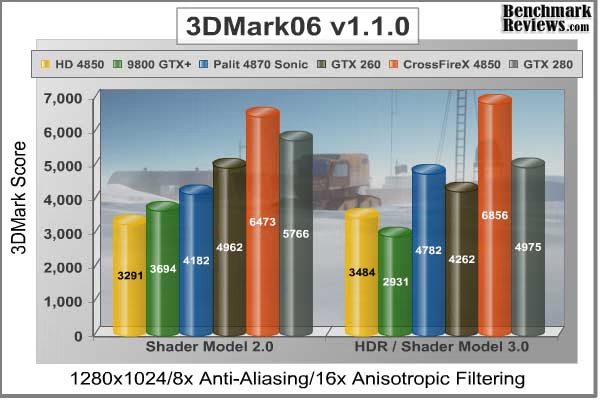
Right away our test results indicate that 3dMark06 benchmarks really like the CrossFireX pair of Sapphire Radeon HD 4850 video cards. But because of the added overhead of combined graphics processors and video frame buffer memory, the light load created by the shader model 2.0 tests have a relatively negative impact on the CrossFireX score. Another way of describing this phenomenon is comparing the combined Radeon HD 4850 video cards to a race car that has only high gears available in the transmission: it will have a faster top-end speed, but it will take longer to get there. The ZOTAC GeForce GTX 280 AMP! Edition video card is appears to also be another high-gear example, as gets nudged-out by the GeForce 9800 GX2 for SM 2.0 tests but outperforms the GX2 in the more complex HDR/SMR 2.0 tests.
In the SM 2.0 tests the Palit Radeon HD 4870 Sonic keeps well ahead of the Radeon HD 4850 and marginally ahead of the GeForce 9800 GTX+ at this resolution. However, moving into the more advanced HDR tests the Radeon HD 4870 produces a much more decisive lead over the 9800 GTX+ and maintains a proportionate lead over the Radeon HD 4850. The interesting news is that the Palit Radeon HD 4870 is beginning to approach the ZOTAC GeForce GTX 280 AMP! Edition's performance level.

At the widescreen resolution of 1680x1050, the scores are practically identical in terms of ratio to all of our previous tests. Once again, the shader model 2.0 tests put the 9800 GTX+ barely ahead of the HD 4850, at least until they reach the shader model 3.0 tests where everything is deeply reversed. Twin Sapphire Radeon HD 4850 video cards in a CrossFireX set are still running circles around the competition in every 3dMark06 benchmark test we conduct, and makes the argument for inexpensive multi-card performance setup. The Palit Radeon HD 4870 actually creeps past the factory overclocked ZOTAC GeForce GTX 280 AMP! Edition in the HDR/Shader Model 3.0 tests.
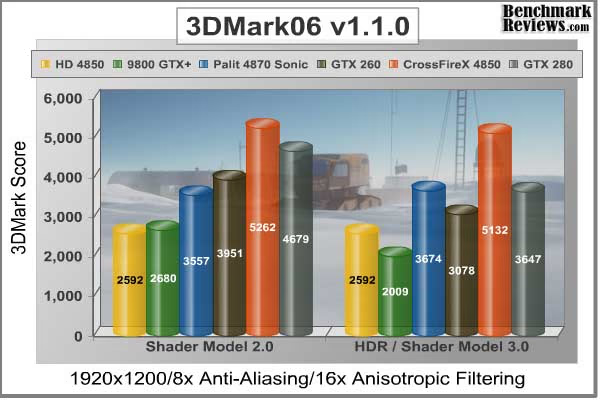
Finishing up the series of synthetic benchmark tests under heavy load, the GeForce 9800 GTX+ video card once again matches the Sapphire Radeon HD 4850 in the SM 2 tests, yet the Radeon HD 4850 dominates over the 9800 GTX+ by 29% in the more demanding shader model 3.0 tests. More impressive is the fact that Palit's Radeon HD 4870 can approach the level of performance demonstrated by the AMP!'ed GTX 280 in SM 2.0 tests. However, taking cost into consideration, the CrossFireX set of Sapphire 4850's outperforms the more expensive GTX 280 by over 40% in 3dMark06; while the Sonic Edition 4870 nearly matches it.
| Product Series | Sapphire Radeon HD 4850 102-B50102-00-AT | ZOTAC GeForce 9800 GTX+ ZT-98PES2P-WSP | Palit Radeon HD 4870 Sonic Dual Edition 4870S+0452-PM9248 |
XFX GeForce GTX 260 GX-260N-ADDU |
ZOTAC GeForce GTX 280 AMP! Edition ZT-X28E3LA-FCP |
|---|---|---|---|---|---|
| Stream Processors | 800 | 128 | 800 | 192 | 240 |
| Core Clock (MHz) | 625 | 740 | 775 | 164 | 700 |
| Shader Clock (MHz) | N/A | 1836 | N/A | 1242 | 1400 |
| Memory Clock (MHz) | 993 | 1100 | 1000 | 1150 | 1150 |
| Memory Amount | 512 MB GDDR3 | 512 MB GDDR3 |
512 MB GDDR5 |
896 MB GDDR3 | 1024 MB GDDR3 |
| Memory Interface | 256-bit | 256-bit | 256-bit | 448-bit | 512-bit |
Take the 3DMark06 tests at face value, because in our next section we begin real-world testing on a cadre of popular video games known for taxing the graphics processor, and the performance curve is expected change. Our first up is Call of Duty 4, so please continue on...
Call of Duty 4 Benchmark Results
Call of Duty 4: Modern Warfare runs on a proprietary game engine that Infinity Ward based off of the tried-and-true Q3 structure. This engine offers features such as true world-dynamic lighting, HDR lighting effects, dynamic shadows and depth of field. "Bullet Penetration" is calculated by the Infinity Ward COD4 game engine, taking into account things such as surface type and entity thickness. Certain objects, such as cars, and some buildings are destructible. This makes distinguishing cover from concealment important, as the meager protection provided by things such as wooden fences and thin walls does not fully shield players from harm as it does in many other games released during the same time period. Bullet speed and stopping power are decreased after penetrating an object, and this decrease is calculated realistically depending on the thickness and surface of the object penetrated.
This version of the game also makes use of a dynamic physics engine, a feature which was not implemented in previous Call of Duty titles for Windows PC's. The new in-game death animations are a combination of pre-set static animations combined with ragdoll physics. Infinity Ward's use of the well-debugged Quake 3 engine along with new dynamic physics implementation allows Call of Duty 4 to be playable by a wide range of computer hardware systems. The performance may be scaled for low-end graphic cards up to 4x Anti-Aliasing and 16x Tri-linear anisotropic texture filtering.
Before I discuss the results, I would like to take a moment to mention my general opinion on Fraps software when it comes to game performance benchmarking. If you're not familiar with the software, Fraps (derived from Frames per second) is a benchmarking, screen capture, and real-time video capture utility for DirectX and OpenGL applications. Some reviewers use this software to measure video game performance on their Windows system, as well as record gaming footage. My opinion is that it offers a valid third-party non-bias alternative to in-game benchmarking tools; but there is one caveat: it's not perfect. Because the user must manually begin the test, the starting point may vary from position to position and therefore skew the results.
In my testing with Fraps v2.9.4 build 7039, I used the cut-scene intro to the coup d'etat scene when Al Asad takes over control. First I allowed the level to load and let the scene begin for a few moments, then I would use the escape key to bring up the menu. Once I selected the restart level option, I would immediately press F11 to begin recording the benchmark data. This scene is nearly four minutes long, but I configured Fraps to record the first 180 seconds of it to remain consistent. Once the scene would end, I would repeat the restart process for a total of five tests. So within a 0.2 second starting point margin, all benchmark results are comparable which is probably as good as it can possibly get with this tool.
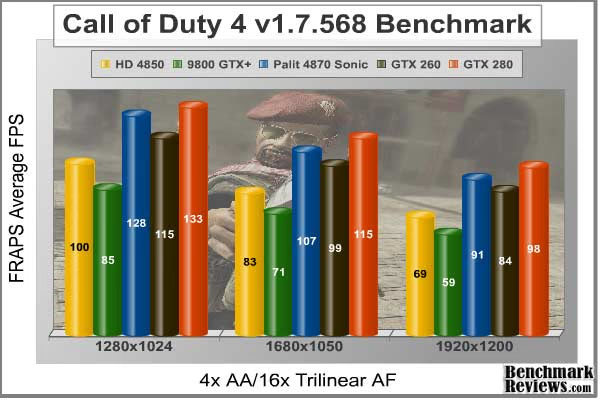
In our frame rate results, all five of the collected test scores were within 0.5 FPS of one-another and then averaged for the chart you see above. Once the tests had been repeated and the results recorded, It was clear that the RV770 was a superior graphics processor when compared to the GT92 GPU, which is to be expected. At the lower resolutions the Radeon HD 4870 was able to close the gap and get within range of the GeForce GTX 280 AMP! Edition, and by the end of our benchmark testing the GTX 260 fell behind the Sonic 4870 by over 8%. The CrossFireX set of Sapphire Radeon HD 4850's was not included in this test.
Call of Duty 4 put a reasonable amount of strain on the Palit Radeon HD 4870 video card, but it seemed that the Sonic Dual Edition video card really took to CoD4. Since the maximum anti-aliasing available in COD4 is 4x, there won't be any problem with the Radeon 4800-series architectural limit of 8x AA. At our highest test resolution of 1920x1200, the Sapphire Radeon HD 4870 beat the 9800 GTX+ by an impressive 54%. The Radeon HD 4850 surpassed the GeForce 9800 GTX+ by 17%, but still trailed behind the Palit 4870 Sonic by 32%.
| Product Series | Sapphire Radeon HD 4850 102-B50102-00-AT | ZOTAC GeForce 9800 GTX+ ZT-98PES2P-WSP | Palit Radeon HD 4870 Sonic Dual Edition 4870S+0452-PM9248 |
XFX GeForce GTX 260 GX-260N-ADDU |
ZOTAC GeForce GTX 280 AMP! Edition ZT-X28E3LA-FCP |
|---|---|---|---|---|---|
| Stream Processors | 800 | 128 | 800 | 192 | 240 |
| Core Clock (MHz) | 625 | 740 | 775 | 164 | 700 |
| Shader Clock (MHz) | N/A | 1836 | N/A | 1242 | 1400 |
| Memory Clock (MHz) | 993 | 1100 | 1000 | 1150 | 1150 |
| Memory Amount | 512 MB GDDR3 | 512 MB GDDR3 |
512 MB GDDR5 |
896 MB GDDR3 | 1024 MB GDDR3 |
| Memory Interface | 256-bit | 256-bit | 256-bit | 448-bit | 512-bit |
In our next section, we shall see if the performance-demanding video game Crysis will help strengthen this position.
Crysis Benchmark Results
Crysis uses a new graphics engine: the CryENGINE2, which is the successor to Far Cry's CryENGINE. CryENGINE2 is among the first engines to use the Direct3D 10 (DirectX10) framework of Windows Vista, but can also run using DirectX9, both on Vista and Windows XP.
Roy Taylor, Vice President of Content Relations at NVIDIA, has spoken on the subject of the engine's complexity, stating that Crysis has over a million lines of code, 1GB of texture data, and 85,000 shaders. To get the most out of modern multicore processor architectures, CPU intensive subsystems of CryENGINE 2 such as physics, networking and sound, have been re-written to support multi-threading.
Crysis offers an in-game benchmark tool, which is similar to World in Conflict. This short test does place some high amounts of stress on a graphics card, since there are so many landscape features rendered. For benchmarking purposes, Crysis can mean trouble as it places a high demand on both GPU and CPU resources. Benchmark Reviews uses the Crysis Benchmark Tool by Mad Boris to test frame rates in batches, which allows the results of many tests to be averaged.
The very first thing we discovered in the low-resolution tests was how seemingly poor the CrossFireX set of Sapphire Radeon HD 4850's performed. At 1280x1024 the ZOTAC GeForce 9800 GTX+ was matched in average frame rate by the Radeon HD 4850, and the Palit 4870 Sonic Dual Edition matched the overclocked GTX 260 and edged out the CrossFireX set of 4850's. To be fair, none of these video cards will probably ever realistically see this low of a resolution, so the performance only illustrates how high-end GPU power can be cut short if the monitor (resolution) doesn't match it.
Low-resolution testing allows the graphics processor to plateau its maximum output performance, which thereby shifts demand onto the other system components. At the lower resolutions Crysis will reflect the GPU's top-end speed in the composite score, indicating full-throttle performance with little load. This makes for a less GPU-dependant test environment, and is helpful in creating a baseline for measuring maximum output performance in the next few test results. At the 1280x1024 resolution used by some newer 17" and most 19" monitors, all of the video cards tested performed at very respectable levels.

The results of our 1280x1024 tests were very much identical in performance ratio to the results of our 1680x1050 tests. In both tests, the Radeon HD 4850 performed on the same level as the 9800 GTX+, and the Palit 4870 Sonic performed the same as the overclocked XFX GeForce GTX 260 and CrossFireX 4580's. The ZOTAC GeForce GTX 280 AMP! Edition distanced itself well ahead of the others, but this would soon change as the demands increased under 1920x1200 conditions.
Reading the results of our 1920x1200-resolution benchmarks using the SOYO DYLM26E6 monitor for testing, Crysis forces 2.3 million pixels to be processed by our graphical test products. At our highest widescreen resolution, the GeForce 9800 GTX+ performs nearly the same as Sapphire's Radeon HD 4850, but the Palit Radeon HD 4870 Sonic Dual Edition comes in 33% higher than both of them. Despite what 3dMark06 previously reported, the CrossFireX set of Radeon HD 4850's is not king in Crysis; the GeForce GTX 280 series is. If only by a small difference, the Sonic 4870 enjoys a 1 FPS lead over the GeForce GTX 260 and came 3 FPS behind the CrossFireX set.
Before we leave Crysis, I decided to include a look at post-processing performance with 4x AA enabled at the 1680x1050 and 1920x1200 resolutions. The chart below shows the average frame rate performance with 4x Anti-Aliasing enabled.

With 4x AA enabled at 1680x1050, the Radeon HD 4850 produces a 2 FPS lead over the GeForce 9800 GTX+. The Palit Radeon HD 4870 video card does well against the CrossFireX set of 4850's, and reports a 2 FPS lead over the overclocked XFX GeForce 260. As if it was really unexpected, ZOTAC's GTX 280 AMP! Edition comes out (way) on top. But once the Honeywell 22-Inch LCD was swapped out, I began testing at 1920x1200 and the differences were made very clear.
At 1920x1200 the proof is self-evident, as the Radeon 4850 easily dominates the 9800 GTX+ by 7 FPS, and comes within 6 FPS of reaching the GeForce GTX 260. The Palit Radeon HD 4870 Sonic produces 26.4 FPS, and narrowly beats the GTX 260, but the CrossFireX set of 4850's leads it by 5 FPS. The heavily overclocked GTX 280 dominates the collection of video cards with a 38.4 frame rate.
With only a small dose of anti-aliasing added to Crysis, there are very few products that would make for playable frame rates. Our Island timedemo mixes a some beach and water views so it's going to be on the high side of frame rates when compared to actual game play, but as you can see the Radeon products do extremely well when post-processing effects are added.
| Product Series | Sapphire Radeon HD 4850 102-B50102-00-AT | ZOTAC GeForce 9800 GTX+ ZT-98PES2P-WSP | Palit Radeon HD 4870 Sonic Dual Edition 4870S+0452-PM9248 |
XFX GeForce GTX 260 GX-260N-ADDU |
ZOTAC GeForce GTX 280 AMP! Edition ZT-X28E3LA-FCP |
|---|---|---|---|---|---|
| Stream Processors | 800 | 128 | 800 | 192 | 240 |
| Core Clock (MHz) | 625 | 740 | 775 | 164 | 700 |
| Shader Clock (MHz) | N/A | 1836 | N/A | 1242 | 1400 |
| Memory Clock (MHz) | 993 | 1100 | 1000 | 1150 | 1150 |
| Memory Amount | 512 MB GDDR3 | 512 MB GDDR3 |
512 MB GDDR5 |
896 MB GDDR3 | 1024 MB GDDR3 |
| Memory Interface | 256-bit | 256-bit | 256-bit | 448-bit | 512-bit |
In our next section, Benchmark Reviews tests the less demanding Unreal Tournament 3 with our collection of video card. Read on to see how a blended medium-demand GPU test with low video frame buffer demand will impact our test products.
Unreal Tournament 3
Unreal Tournament 3 (UT3) is a first-person shooter and online multiplayer video game by Epic Games and is the next installment of the Unreal series after Unreal Tournament 2004. It is published by Midway Games and was released in North America for Windows on November 19, 2007.
Unreal Tournament 3 is actually the fourth game in the Unreal Tournament series and the eighth Unreal game, but it has been numbered in terms of the engine it runs on. UT3 is subsequently part of the third generation, because it runs on the Unreal Engine 3, and does not reuse any content from previous versions.
Since Unreal Tournament 3 was designed as a DirectX 9 video game with no current support expected for DirectX 10, we use Windows XP Pro (Service Pack 3) for our benchmark testing. After completing tests on a wide range of products with settings at their highest, it appeared that Unreal Tournament 3 really didn't stress the video cards nearly as much as I would have liked.
Beginning at the low resolution of 1280x1024, the benchmark scores are so close (and suspiciously high) for our collection of products that it might be time to eliminate this game from our testing process. Nevertheless, it looks like the Unreal Engine 3 game engine doesn't care too much for the ATI Radeon HD 4850 or 4870 video cards. Even the CrossFireX set was just barely able to keep pace with the others that it surpassed in previous tests. With all High Quality settings and tweaks enabled along with 16x anisotropic filtering, Unreal Tournament 3 doesn't add strain to any of the graphics cards tested like Crysis did.
As the resolution was raised, the GeForce 9800 GTX+ eventually leveled out between the Radeon HD 4850 and Palit 4870, which is really where the 55nm G92 product belongs for a low-demand game such as this one. The ZOTAC GeForce GTX 280 AMP! Edition loses just a single frame per second (0.6%) between 1280x1024 and 1680x1050, and the Sapphire Radeon 4850 drops only 6%. For now it appears that just about any graphics card can play Unreal Tournament 3 without issue, but quite frankly I don't know anyone who actually plays this game.
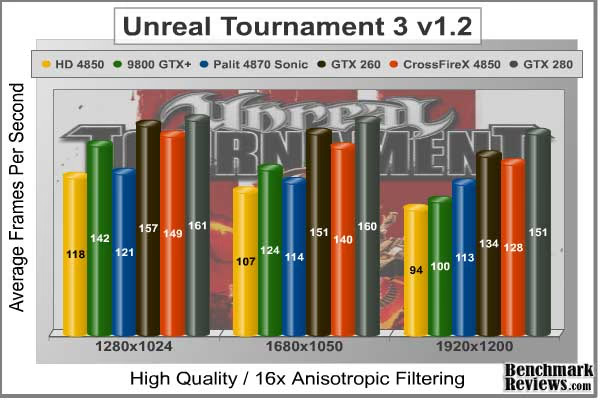
When I tested the Honeywell HWLM2216 recently, I noticed how the 1680x1050 widescreen display resolution of this 22" LCD monitor offered very little strain over a 19" standard display LCD monitor. Comparatively, 1680x1050 produces 1.76 MP and 1280x1024 produces 1.31, so there's only a very small difference expected between performance levels. The biggest difference is in the user experience, because the widescreen monitor comes in very handy for watching multimedia video or playing large world-scape video games.
At 1680x1050 resolution, the differences were beginning to show, but only 1920x1200 will be useful for illustrating how each product performs. Producing 2.3 MP with a 1920x1280 resolution on our 26" SOYO DYLM26E6 test monitor, each product is now separated far enough apart to sort out the winners and losers. The Sapphire Radeon HD 4850 still trails behind the GeForce 9800 GTX+ by 6 FPS, but put another 4850 together for a CrossFireX set and they lead by 28 FPS. The Palit Radeon HD 4870 Sonic enjoys a 13 FPS lead over that same GeForce 9800 GTX+, but the GeForce GTX 260 beats the 4870 and both CrossFireX 4850's by 21 FPS and 6 FPS respectively. When everything was said and done, the overclocked ZOTAC GTX 280 AMP! Edition video card once again topped the other product, producing a 38 FPS lead over the Sonic Dual Edition video card.
Unreal Tournament 3 appears to provide a very minimal load on the high-end video cards we're testing. Thankfully there are several new games arriving to market late into 2008, so with some luck this benchmark will only be used for low-end graphics comparison into the future.
| Product Series | Sapphire Radeon HD 4850 102-B50102-00-AT | ZOTAC GeForce 9800 GTX+ ZT-98PES2P-WSP | Palit Radeon HD 4870 Sonic Dual Edition 4870S+0452-PM9248 |
XFX GeForce GTX 260 GX-260N-ADDU |
ZOTAC GeForce GTX 280 AMP! Edition ZT-X28E3LA-FCP |
|---|---|---|---|---|---|
| Stream Processors | 800 | 128 | 800 | 192 | 240 |
| Core Clock (MHz) | 625 | 740 | 775 | 164 | 700 |
| Shader Clock (MHz) | N/A | 1836 | N/A | 1242 | 1400 |
| Memory Clock (MHz) | 993 | 1100 | 1000 | 1150 | 1150 |
| Memory Amount | 512 MB GDDR3 | 512 MB GDDR3 |
512 MB GDDR5 |
896 MB GDDR3 | 1024 MB GDDR3 |
| Memory Interface | 256-bit | 256-bit | 256-bit | 448-bit | 512-bit |
Our last benchmark of the article is coming next, which puts our collection of video cards against some very demanding graphics.
World in Conflict Benchmark Results
The latest version of Massive's proprietary Masstech engine utilizes DX10 technology and features advanced lighting and physics effects, and allows for a full 360 degree range of camera control. Massive's MassTech engine scales down to accommodate a wide range of PC specifications, if you've played a modern PC game within the last two years, you'll be able to play World in Conflict.
World in Conflict's FPS-like control scheme and 360-degree camera make its action-strategy game play accessible to strategy fans and fans of other genres... if you love strategy, you'll love World in Conflict. If you've never played strategy, World in Conflict is the strategy game to try.
Based on the test results charted below it's clear that WiC doesn't place a limit on the maximum frame rate (to prevent a waste of power) which is good for full-spectrum benchmarks like ours, but bad for electricity bills. The average frame rate is shown for each resolution in the chart below. For the entire range of resolutions the Radeon HD 4850 and GeForce 9800 GTX+ run neck-and-neck, which makes sense for two same-priced graphics cards. Early on in testing at the 1280x1024 The CrossFireX set of HD 4850's are just a step behind the average frame rate of the GTX 260, and only 3 FPS ahead of the Palit 4870 frame rate. Ultimately the overclocked ZOTAC GTX 280 would secure the lead with an average frame rate of 66 FPS; but a 2 FPS lead over the GeForce GTX 260 is not exactly impressive.

At 1680x1050 the workload increased only a small amount, but the results were beginning to change ever so slightly. The positions all remain the same, with exception to the CrossFire set, and the performance ratio between products remains consistent. With a balanced demand for CPU and GPU power, World in Conflict just begins to place demands on the graphics processor at the 1920x1280 resolution. I was expecting more results along the same line I've seen so far, and that is pretty much exactly what I got.
The performance decay had its hardest impact on the lower high-level video cards: GeForce 9800 GTX+ and Radeon HD 4850, which for all intents and purposes performed exactly the same throughout our entire WiC testing. Combine two Radeon HD 4850's in a CrossFireX configuration and they will yield a 46% improvement over using only one, while still exceeding the performance of a single heavily-overclocked Palit Radeon HD 4870 Sonic. The GeForce GTX 280 barely moved a frame as it scaled from 1.31 MP up to 2.3 MP (1920x1200), showing how much raw power this product delivers in the right application. Taking a broader look at the average frame rate, it appears that only the mid-level GeForce 9800 GTX+ and Sapphire Radeon HD 4850 demonstrate a major performance decay as the resolution is raised.
| Product Series | Sapphire Radeon HD 4850 102-B50102-00-AT | ZOTAC GeForce 9800 GTX+ ZT-98PES2P-WSP | Palit Radeon HD 4870 Sonic Dual Edition 4870S+0452-PM9248 |
XFX GeForce GTX 260 GX-260N-ADDU |
ZOTAC GeForce GTX 280 AMP! Edition ZT-X28E3LA-FCP |
|---|---|---|---|---|---|
| Stream Processors | 800 | 128 | 800 | 192 | 240 |
| Core Clock (MHz) | 625 | 740 | 775 | 164 | 700 |
| Shader Clock (MHz) | N/A | 1836 | N/A | 1242 | 1400 |
| Memory Clock (MHz) | 993 | 1100 | 1000 | 1150 | 1150 |
| Memory Amount | 512 MB GDDR3 | 512 MB GDDR3 |
512 MB GDDR5 |
896 MB GDDR3 | 1024 MB GDDR3 |
| Memory Interface | 256-bit | 256-bit | 256-bit | 448-bit | 512-bit |
In our next section, we discuss electrical power consumption and learn how well (or poorly) each video card will impact your utility bill...
4870 Sonic Power Consumption
Life is not as affordable as it used to be, and items such as gasoline, natural gas, and electricity all top the list of resources which have exploded in price over the past few years. Add to this the limit of non-renewable resources compared to current demands, and you can see that the prices are only going to get worse. Planet Earth is needs our help, and needs it badly. With forests becoming barren of vegetation and snow capped poles quickly turning brown, the technology industry has a new attitude towards suddenly becoming "green". I'll spare you the powerful marketing hype that I get from various manufacturers every day, and get right to the point: your computer hasn't been doing much to help save energy... at least up until now.
To measure isolated video card power consumption, Benchmark Reviews uses the Kill-A-Watt EZ (model P4460) power meter made by P3 International. A baseline test is taken without a video card installed inside our computer system, which is allowed to boot into Windows and rest idle at the login screen before power consumption is recorded. Once the baseline reading has been taken, the graphics card is installed and the system is again booted into Windows and left idle at the login screen. Our final loaded power consumption reading is taken with the video card running a stress test using FurMark. Below is a chart with the isolated video card power consumption (not system total) displayed in Watts for each specified test product:
VGA Product Description(sorted by combined total power) |
Idle Power |
Loaded Power |
|---|---|---|
NVIDIA GeForce GTX 480 SLI Set |
82 W |
655 W |
NVIDIA GeForce GTX 590 Reference Design |
53 W |
396 W |
ATI Radeon HD 4870 X2 Reference Design |
100 W |
320 W |
AMD Radeon HD 6990 Reference Design |
46 W |
350 W |
NVIDIA GeForce GTX 295 Reference Design |
74 W |
302 W |
ASUS GeForce GTX 480 Reference Design |
39 W |
315 W |
ATI Radeon HD 5970 Reference Design |
48 W |
299 W |
NVIDIA GeForce GTX 690 Reference Design |
25 W |
321 W |
ATI Radeon HD 4850 CrossFireX Set |
123 W |
210 W |
ATI Radeon HD 4890 Reference Design |
65 W |
268 W |
AMD Radeon HD 7970 Reference Design |
21 W |
311 W |
NVIDIA GeForce GTX 470 Reference Design |
42 W |
278 W |
NVIDIA GeForce GTX 580 Reference Design |
31 W |
246 W |
NVIDIA GeForce GTX 570 Reference Design |
31 W |
241 W |
ATI Radeon HD 5870 Reference Design |
25 W |
240 W |
ATI Radeon HD 6970 Reference Design |
24 W |
233 W |
NVIDIA GeForce GTX 465 Reference Design |
36 W |
219 W |
NVIDIA GeForce GTX 680 Reference Design |
14 W |
243 W |
Sapphire Radeon HD 4850 X2 11139-00-40R |
73 W |
180 W |
NVIDIA GeForce 9800 GX2 Reference Design |
85 W |
186 W |
NVIDIA GeForce GTX 780 Reference Design |
10 W |
275 W |
NVIDIA GeForce GTX 770 Reference Design |
9 W |
256 W |
NVIDIA GeForce GTX 280 Reference Design |
35 W |
225 W |
NVIDIA GeForce GTX 260 (216) Reference Design |
42 W |
203 W |
ATI Radeon HD 4870 Reference Design |
58 W |
166 W |
NVIDIA GeForce GTX 560 Ti Reference Design |
17 W |
199 W |
NVIDIA GeForce GTX 460 Reference Design |
18 W |
167 W |
AMD Radeon HD 6870 Reference Design |
20 W |
162 W |
NVIDIA GeForce GTX 670 Reference Design |
14 W |
167 W |
ATI Radeon HD 5850 Reference Design |
24 W |
157 W |
NVIDIA GeForce GTX 650 Ti BOOST Reference Design |
8 W |
164 W |
AMD Radeon HD 6850 Reference Design |
20 W |
139 W |
NVIDIA GeForce 8800 GT Reference Design |
31 W |
133 W |
ATI Radeon HD 4770 RV740 GDDR5 Reference Design |
37 W |
120 W |
ATI Radeon HD 5770 Reference Design |
16 W |
122 W |
NVIDIA GeForce GTS 450 Reference Design |
22 W |
115 W |
NVIDIA GeForce GTX 650 Ti Reference Design |
12 W |
112 W |
ATI Radeon HD 4670 Reference Design |
9 W |
70 W |
The Palit Radeon HD 4870 is no stranger to high power bills based on the fact that it reaches the top our chart for power consumption under load. Even at idle, the Sonic Dual Edition video card gulps the watts down at a faster pace than the GeForce 9800 GX2. Regardless, the power requirements for the Radeon HD 4870 consist of two six-pin PCI-Express power connections to ensure that the RV770 receives enough juice to push out the frames in 3D mode. This may leave some middle-market enthusiasts and lower-end gamers in search of a new power supply force feed the Radeon HD 4870 the power it needs.
Most enthusiasts make the mistake of associating a smaller die process with an improved power efficiency. Clearly, the downside to the 55 nm RV770 GPU is it's lack of energy efficient operation. The power consumption measured under full load doesn't match the performance, but it certainly matched heat output. The idle power draw is extremely high, which is uncommon since emphasis is usually placed on idle/standby mode efficiency and conservation.

Taken as a whole the idle stand-by power consumption is pretty unforgivable, especially since this the condition your equipment will be in the majority of the time. While loaded power consumption is the highest we've ever seen, the price paid to your utility company for gaming would be about the same with just about any other video card. Once upon a time, the computer and gaming consoles seemed like an inexpensive alternative to arcade gaming... but that was before energy costs soared through the roof.
Please continue to the review conclusion in the next section, where I share my final thoughts on the RV770 graphics processor and give my opinion of the new Radeon HD 4800-series product offerings.
Radeon 4800-Series Final Thoughts
There's a lot to like about the new Radeon HD 4800 series of products. To begin with, 800 cores is nothing to scoff at; even if they aren't nearly as efficient as they sound. CrossFireX scales performance very well, and for the first time actually makes multi-card setups worth the money. The most likable part of the Radeon HD 4850 is that it debuted at under $200, forcing NVIDIA to drop the price of their GeForce 9800 GTX+ to meet with the competition. When ATI launched the Radeon HD 4870 at $300, NVIDIA had to answer back by dropping the GTX 260 to a more affordable price. But that's where everything becomes tricky, and the value of ATI's latest product comes into question.
But here's why clarifying how the value has become so tricky to define. The initial interest in a product like the Radeon HD 4850 lies in the fact that it competes head-on with the GeForce 9800 GTX. But now that they are both priced the same, value takes on a new dimension. In each and every test I conducted, the Radeon HD 4850 kept up with the GeForce 9800 GTX but never outperformed it (until 4x AA was added to Crysis). This would be the main reason why I see value becoming more of an issue outside of video game performance. The GeForce 9800 GTX+ offers HDMI, and so does the Radeon HD 4850. Both offer essentially the same exact sub-features down the line, except for when it comes to multi-card configurations; which is where the CrossFireX configuration really comes to shine.
I am very much aware that NVIDIA offers SLI just like ATI offers CrossFireX, but what I'm talking about is multi-card compatibility with motherboards. AMD Didn't exactly impress the world with Phenom, and thus the world hasn't jumped onboard to use their processors. Instead, Intel scooped up a large share of the consumer base with their P35/X38/P45/X48 chipsets (all launched within about ten minutes from each other). But here's my point: ATI still wins. All of these Intel motherboards, along with all of the AMD motherboards, offer CrossFire support exclusively. NVIDIA is left holding their own hand, because only their own chipsets will support SLI... at least until we Intel launches the X58 chipset which is expected to combine their technology with SLI in special versions of the product.

I'm not entirely sold on everything that the chipmakers would like for us to believe. I think it's sometimes worth questioning the wisdom, and in this regard I find that AMD is trying to pull one over on consumers by describing their RV770 to have 800 scalar processors. The reality is that ATI's 800 stream processor cores do not compare 1:1 against the competition, especially since the GeForce 9800 GTX can outperform the Radeon HF 4850 with only 128 shader cores. So despite what ATI would like to market, scalar processors they are not as they function exactly like vector processors would. With 800 processor cores residing in five bank location, each series of 5 processor cores process only one vector unit at a time - even if that vector doesn't need to use all five processor cores. 800 Cores are there, but they are far from the efficiency level seen by the competition.
My final thoughts on the 4800-series is where the Radeon 4850 and 4870 come up short. They're both great products just so that we're clear, but for a 55 nm process there's a lot missing from the RV770's arsenal that really should be there. I consider efficiency at the very start of this list, and even though my first lesson on the relationship between die process size and energy efficiency came from Mr. Jen-Hsun Huang, President of NVIDIA, I later researched this on my own to discover that he was correct: reduced die process does not equal increased energy efficiency. Obviously this phenomenon holds up very well against the power consumption results I've tested for this review.
ATI's memory bus architecture also has me questioning their efforts. NVIDIA can produce a 512-bit memory bus for a 1:1 ratio of memory to interface (512MB @ 512-bit), so it's just a little disappointing that ATI did not do the same for their Radeon HD 4850 and 4870 (which uses GDDR5). Perhaps if I lower my expectations on improvements towards technology, I could accept a 256-bit Radeon HD 4850, but if you're going to make GDDR5 your marketing headline then perhaps you should also do something to match the technical achivements found in competing products. Notwithstanding, memory bandwidth is far from being saturated by today's software (and hardware interface limits), and so my complaint is really more of a moot point, but it still stands to reason that AMD missed an opportunity here.
Palit Radeon 4870 Conclusion
For those not up on manufacturer personalities, Frobot is Palit's half-frog half-robot character that makes an appearance on each product package. Presentation is always the first summary I give in each product review conclusion, but ironically this mundane topic seldom provides the same outcome. Palit, a company who has used several color schemes to catch our consumer attention, switches gears and goes candy-apple red for the Sonic Dual Edition video card. There's plenty of information on the package, which should help educate the inexperienced enthusiast.
Judging the product appearance is a little more difficult than I'm used to. Lately, almost everything has been encased in plastic housings with a contoured finish. This doesn't mean that you can't look sharp without the extra plastic body work, but there's a level of protection all of that stuff provides which goes missing on ATI products. Still, Palit has done a very good job mixing red hues with black component accents, making the Radeon HD 4870 look as fast as it actually performs.

Construction is solid, but not without some concerns. I absolutely appreciate ATI for not placing memory module IC's on the back side of the PCB, but at the same time I have to hold Palit accountable for the cooling unit. If you've read any or my video card reviews, you'll know how much I dislike VGA coolers that exhaust back into the computer case... no matter how well they cool. While this is a rather null complaint (because the dual fans cool the unit superbly), I still think that dual-slot video cards should exhaust outside of the computer case. Aside from this, the construction is solid and all electronics are well protected.
In terms of performance, the Palit Radeon HD 4870 Sonic Edition usually performed around 30% better than the Radeon HD 4850 and GeForce 9800 GTX+. During Crysis testing with 4x AA added, this Radeon HD 4870 video card was unable to outperform the overclocked GeForce GTX 260 or 280 we used, but it matched the performance of our CrossFireX set of 4850's. Alternatively, the less NVIDIA-biased Call of Duty 4 placed the Palit 4870 right between the factory-overclocked GTX 260 and trailing behind the GTX 280 AMP! Edition. As a graphics processor, the RV770 performed incredibly well; but I didn't see much evidence of this overclocked 4870 beating its GTX 280 counterpart.
Value is always relative to supply and demand, along with whatever retailers think they can get from the consumer audience at any particular time. At the time of this writing, the Palit Radeon HD 4870 is being sold at NewEgg for $269.99 with a rebate available. This price comes about $100 or more below the GTX 280 we compared, making the argument sway in Palit's favor. Even still, I think the Radeon HD 4870 series will still see a small price reduction after the initial glow of a fresh product launch fades away.
In conclusion, my final recommendation on the Palit Radeon HD 4870 Sonic Dual Edition is very good but not so great that you should ignore the options. On its own accord, the 4870 would occasionally reach the level of performance seen from the GeForce GTX 260 but never actually dominated over it. Taken into consideration, you have to look at price and sub-feature offerings. It's no surprise that CrossFire and CrossFireX are available on just about every single motherboard that fits an Intel or AMD processor; the same is hardly true for the SLI. So then it's down to price. Since NVIDIA submitted to ATI's price point, both the GTX 260 and Radeon 4870 are now offered around the same cost. At the end of this point there's really no decisive victory to be handed out. In summary, the Palit Radeon HD 4870 is an outstanding product with a few convenience features over the alternative, so the decision is going to come down to personal preference and available pricing.
Pros:
+ Native DisplayPort output
+ Dual-Mode BIOS and smart switch
+ Extremely good AA/AF performance for higher-end games
+ Supports DirectX 10 and Shader Model 4.0
+ 775 MHz GPU / 1000 MHz GDDR5 vRAM
+ Features ATI AVIVO Technology
+ 1080p HDMI Audio and Video supported for HDCP output
+ Quiet fans under normal operation
+ Introduces new TeraScale Graphics Engine technology
+ Exceptional dual-fan cooling solution
+ Supports CrossFireX functionality
+ 24x Custom filter anti-aliasing (CFAA)
+ 5 GBps PCI Express 2.0 graphics interface
Cons:
- Consumes more power than most other single-GPU products tested
- Maximum post-processing Anti Aliasing is limited to 8x
- Fan noise can grow to a noticeable level under full load
- Does not exhaust outside of computer case
- Kit does not include CrossFireX bridge component
Ratings:
-
Presentation: 9.00
-
Appearance: 9.25
-
Construction: 9.00
-
Functionality: 9.00
-
Value: 8.50
Final Score: 8.95 out of 10.
Questions? Comments? Benchmark Reviews really wants your feedback. We invite you to leave your remarks in our Discussion Forum.